
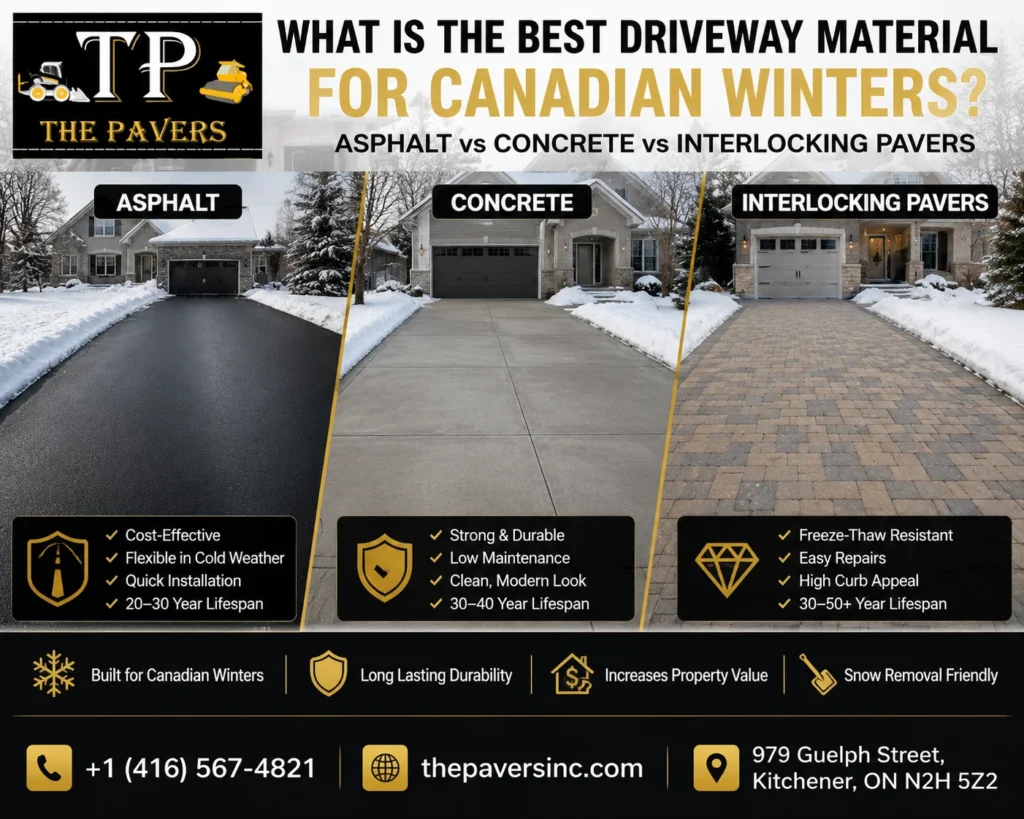
Canadian winters are known for heavy snowfall, ice buildup, road salt exposure, and constant freeze-thaw cycles. These conditions can significantly impact the lifespan and performance of any driveway. Choosing the best driveway material for Canadian winters is one of the most important investments homeowners can make to protect their property, improve curb appeal, and reduce long-term maintenance costs.
When comparing asphalt vs concrete driveway options and interlocking vs asphalt driveway solutions, each material offers unique advantages. Understanding durability, installation costs, maintenance requirements, and winter performance can help you make the right decision for your home.
In this guide, we’ll compare asphalt, concrete, and interlocking pavers to determine what is the best driveway material for Canadian winters and which option delivers the best value for homeowners in Ontario and across Canada.
Why Canadian Winters Are Hard on Driveways
Canada’s climate presents several challenges for driveway materials:
- Freeze-thaw cycles cause expansion and contraction
- Snow removal equipment can damage surfaces
- Road salt accelerates deterioration
- Ice buildup creates safety hazards
- Heavy vehicles increase stress during winter months
The ideal driveway material should offer:
- Strong winter weather resistance
- Excellent durability
- Minimal cracking
- Easy snow removal
- Long lifespan
- Attractive appearance
- Good return on investment
Asphalt vs Concrete vs Interlocking Driveway Comparison
| Feature | Asphalt | Concrete | Interlocking Pavers |
|---|---|---|---|
| Winter Performance | Excellent | Moderate | Excellent |
| Lifespan | 20-30 Years | 30-40 Years | 30-50+ Years |
| Freeze-Thaw Resistance | High | Moderate | Very High |
| Crack Resistance | Good | Moderate | Excellent |
| Snow Removal Friendly | Excellent | Excellent | Excellent |
| Maintenance Costs | Medium | Low-Medium | Low |
| Repairability | Moderate | Difficult | Easy |
| Curb Appeal | Good | Good | Excellent |
| Property Value Increase | Moderate | Good | Excellent |
| Installation Cost | Lowest | Medium | Highest |
Asphalt Driveways: Pros and Cons for Canadian Winters
Advantages of Asphalt Paving
Asphalt remains one of the most popular Canadian driveway solutions because it performs well in cold climates.
Benefits include:
- Flexible surface adapts to temperature changes
- Lower upfront installation cost
- Fast installation process
- Easy snow plowing and shoveling
- Good winter weather resistance
Many homeowners choose asphalt driveway installation because it offers affordability and dependable performance.
Asphalt Driveway Lifespan
A professionally installed asphalt driveway typically lasts:
- 20–30 years with maintenance
- Longer when regularly sealed
Drawbacks of Asphalt
- Requires sealing every 2–3 years
- Vulnerable to oil stains
- Can soften during extreme summer heat
- Periodic resurfacing may be required
Best For:
Homeowners seeking the most cost-effective driveway option with reliable winter performance.
Concrete Driveways: Pros and Cons
Benefits of Concrete Driveways
Concrete offers a clean, modern appearance and excellent strength.
Advantages include:
- Long lifespan
- Minimal routine maintenance
- Bright appearance improves curb appeal
- Strong load-bearing capacity
Many concrete driveway contractors recommend reinforced concrete for residential properties.
Concrete Driveway Lifespan in Canada
Properly installed concrete can last:
- 30–40 years
- Occasionally longer with proper maintenance
Concrete Driveway Pros and Cons in Cold Climates
The primary challenge with concrete is freeze-thaw damage.
Potential issues include:
- Surface scaling from salt exposure
- Cracking caused by freezing temperatures
- More expensive repairs than asphalt
- Longer curing times
Although durable, concrete is generally less forgiving than asphalt when exposed to repeated freeze-thaw cycles.
Best For:
Homeowners prioritizing appearance and long-term durability over initial cost.
Interlocking Pavers: The Premium Choice for Canadian Winters
Why Interlocking Driveways Perform So Well
Interlocking pavers are increasingly considered the best driveway for Ontario winter weather because they are designed to move naturally with seasonal ground shifts.
Benefits include:
- Exceptional freeze-thaw resistance
- Individual pavers can move without cracking
- Easy repairs
- Superior drainage
- Outstanding curb appeal
These characteristics make interlocking one of the most winter resistant driveway materials available.
Interlocking Driveway Lifespan
A professionally installed interlocking driveway can last:
- 30–50+ years
- Often longer with proper maintenance
Interlocking Driveway Benefits
- Crack-resistant driveway solution
- Easy paver replacement
- Excellent snow and ice performance
- Increased property value
- Premium appearance
- Low maintenance requirements
Do Interlocking Pavers Crack in Winter?
Unlike poured concrete, interlocking pavers rarely experience large structural cracks. Individual pavers can be replaced if damage occurs, making repairs simple and affordable.
Best For:
Homeowners seeking maximum durability, luxury appearance, and long-term value.
Driveway Installation Cost Comparison in Ontario
Asphalt
Average Cost:
- $7–$15 per square foot
Concrete
Average Cost:
- $10–$20 per square foot
Interlocking Pavers
Average Cost:
- $18–$35+ per square foot
While interlocking pavers have the highest initial investment, they often provide the strongest long-term return due to longevity and repairability.
Which Driveway Material Lasts the Longest in Canada?
If longevity is the primary concern:
- Interlocking Pavers: 30–50+ Years
- Concrete: 30–40 Years
- Asphalt: 20–30 Years
Interlocking systems consistently rank among the most long lasting driveway options available in freezing climates.
Which Driveway Requires the Least Maintenance?
Lowest Maintenance Ranking
- Interlocking Pavers
- Concrete
- Asphalt
Asphalt requires regular sealing and occasional resurfacing, while interlocking systems typically need only periodic joint sand replenishment and cleaning.
Which Driveway Adds the Most Home Value?
Homebuyers often view driveways as part of a property’s overall curb appeal.
For property value increase and driveway ROI in Canada, interlocking pavers generally provide the highest return.
Benefits include:
- Premium appearance
- Improved landscaping aesthetics
- Enhanced curb appeal improvement
- Long lifespan
- Increased buyer interest
Many homeowners ask: Does an interlocking driveway increase home value?
The answer is yes. A professionally installed interlocking driveway often enhances both perceived and actual property value.
Expert Recommendation: What Is the Best Driveway Material for Canadian Winters?
For homeowners seeking the best overall performance:
Best Overall
Interlocking Pavers
Why?
- Exceptional freeze-thaw resistance
- Longest lifespan
- Easy repairs
- Highest curb appeal
- Strong property value increase
Best Budget-Friendly Option
Asphalt
Why?
- Lowest installation cost
- Excellent cold-weather flexibility
- Good durability
Best Modern Appearance
Concrete
Why?
- Clean aesthetic
- Strong structural performance
- Long service life
Frequently Asked Questions
Which type of driveway material is ideal for the winter?
Interlocking pavers are widely considered the best option because they resist freeze-thaw damage, provide excellent drainage, and allow easy repairs.
Which driveway is best for Canadian winters?
Interlocking pavers generally outperform asphalt and concrete due to superior flexibility and durability during harsh winters.
Which is better for cold climates: concrete or asphalt?
Asphalt typically performs better than concrete because it is more flexible and less prone to cracking during temperature fluctuations.
Are interlocking pavers good for snow?
Yes. Interlocking pavers handle snow removal well and resist damage from freeze-thaw cycles.
What driveway material lasts the longest?
Interlocking pavers usually last 30–50+ years, making them one of the longest-lasting driveway materials available.
Which driveway requires the least maintenance?
Interlocking pavers typically require the least maintenance while offering easy repairs if needed.
What is the cheapest driveway material?
Asphalt is generally the most affordable driveway material for residential properties in Canada.
Do interlocking driveways add value to a home?
Yes. Interlocking driveways improve curb appeal and can increase property value significantly.
How often should an asphalt driveway be sealed?
Most asphalt driveways should be sealed every 2–3 years to maximize lifespan and performance.
Can concrete driveways survive freeze-thaw cycles?
Yes, but proper installation and maintenance are critical to prevent cracking and surface deterioration.
Conclusion
When evaluating the best driveway material for Canadian winters, the answer depends on your budget, maintenance expectations, and long-term goals. Asphalt offers affordability and solid winter performance. Concrete delivers strength and a clean appearance. However, for homeowners seeking the ultimate combination of durability, curb appeal, freeze-thaw resistance, and property value, interlocking pavers remain the top choice.
If you’re planning a driveway replacement, new installation, or renovation project in Ontario, comparing materials carefully today can save thousands of dollars in maintenance and repairs over the coming decades.